Rules and Regulations
2026 NFHS Rules Changes
Girls Lacrosse Rules Changes - 2026
By NFHS on September 19, 2025
2-4-5: Stick checks may be requested at any point during a quarter break, halftime, a team time-out, prior to the start of an overtime period, prior to the start of a draw, and immediately following goals in regulation and overtime periods.
Rationale: Specifies the appropriate times when stick check requests may be made to eliminate potential gamesmanship, maintain pace of play, and allow officials to focus on administration of the game.
2-8-3 (NEW) & PENALTY: No on-field player can wear an audio or video device during the game.
Rationale: Clarifies the prohibition of electronic communications with and by players during the game and aligns with other NFHS rules codes.
4-3-3d: If a possession time-out is called when the goalkeeper has possession of the ball in the goal circle, play will resume at the closest dot and any player may restart play.
Rationale: Aligns the restart procedure for a team time-out when the goalkeeper has possession of the ball in the goal circle with other team time-outs when the ball is in the critical scoring area.
5-2 PENALTY 1: When one player draws illegally, the free position may be taken by any player on the opponent’s team at the spot of the ball.
Rationale: Improves the flow of the game without disadvantaging the non-offending team.
7-3 PENALTIES 1a, 3a: When a goal circle foul is committed, the offending player shall move 4 meters away from the player taking the free position instead of behind.
Rationale: Improves the flow of the game and creates consistency in penalty administration of non-major fouls.
2026 Girls Lacrosse Editorial Changes
2-2-4; 2-7-1a, 4 & 5 (NEW); 2-7-6; 4-4; 5-4-1 & 2; 7-1-3; 8-1-1 NOTE; 10-1 PENALTIES; 10-1 PENALTIES 6; 10-1 PENALTIES 13b; 11-1-1; 11-2 PENALTIES 2 thru 6; 12-3-2; 12-8 MISCONDUCT PENALTIES 3e; 12-8 COACH MISCONDUCT PENALTIES 2; 13 FLAG; 13 RESTRAINING LINE
2026 Girls Lacrosse Points of Emphasis
- Identifying and Managing Fouls During Scoring Plays
- Efficient Draw Administration
- Delay of Game/Use of the Green Card
Identifying and Managing Fouls During Scoring Plays
Increased attention to offensive and defensive fouls during a scoring opportunity is needed because of a high risk of illegal play. Understanding, recognizing and penalizing major fouls is critical for officials to manage a safe game. These fouls include cross-checking, crosse in the sphere, and illegal stick-to-body contact by the defense; as well as forcing through and charging by the ball carrier.
Additionally, identifying cardable fouls – such as dangerous follow-through dangerous propelling, checks to the head, and dangerous contact to a defenseless player – and penalizing these actions is necessary enforcement and improves safety during a scoring play.
Watching for defenders that play legally and with safe and proper contact during a scoring play improves officials’ ability to recognize when attack players are creating dangerous play. Taking swift and stringent actions in these situations will lead to a safer game and a better experience for all participants.
Efficient Draw Administration
The draw plays a crucial role in girls lacrosse. It determines possession and can influence momentum. Players, coaches and officials play a role in improving the efficiency of the draw and decreasing the time between goals and the start of play. Delayed draw administration, due to lack of readiness by a team or lengthy set up of the draw by officials, detracts from the flow of the game. Efficient draw administration requires:
- Players limit post goal huddles and celebrations and promptly move to draw positioning.
- Coaches substitute players efficiently. Remember, players subbing into the game after a goal may enter the playing field prior to their teammate leaving the field.
- Teams quickly exchange sticks before the draw when they choose to do so to avoid delaying the draw when the officials and opponents are ready.
- Officials gather the ball after the goal and immediately move to the center. Players should never be waiting for the official to get to the draw.
- Officials set the draw properly without delay. Players that are uncooperative or continue to move after the sticks are set should be penalized for a delay of game.
Consistent and proper administration of the draw promotes fairness, minimizes unnecessary delays and supports game flow.
Delay of Game/Use of the Green Card
Proper use of the green card by officials continues to be a point of emphasis. This is important to discourage and penalize fouls that disrupt the flow of the game. Effective green card management will enforce fair play and minimize repeated violations.
The following are common examples of delay-of-game violations that should be penalized with a green card:
- Defenders failing to promptly move 4 meters away from a free position.
- Offenders continuing to run down the field after committing a foul in the midfield, rather than taking action to move 4 meters away from or behind the ball carrier.
- Players failing to promptly clear the penalty zone.
- Teams failing to promptly return to the field after the time-out or when the time between quarters has expired.
The penalties for delay of game are:
- First violation – A green card is issued to the offending team and a change of possession.
- Second violation – A green/yellow card is issued to the offending player for a major foul. The offending player must leave the field for two minutes. This card is not included in the team or player’s card count.
- Third and subsequent violations – A yellow card is issued to the offending player or team for misconduct. A player will leave the field for two minutes. The card is included in the team and player’s card count.
Proper use of the green card discourages activities that delay the game, improves the flow of the game and contributes to a more enjoyable game experience.
2026 Comments on the Rules
Girls Lacrosse Comments on the Rules - 2026
2-4-5 — Stick checks may be requested during quarter and halftime breaks, team timeouts, immediately following goals, or prior to the start of a draw. This eliminates the option for checks during general clock stoppages, helping to maintain game flow, discouraging potential gamesmanship and allowing officials to focus on administration of the game.
2-8-3 (NEW) & PENALTY — Clarifying and prohibiting the use of audio and video equipment by on-field players, reinforces fair play and ensures that electronic communication is not used during competition. This language aligns with other NFHS sport codes.
4-3-3d — Play will resume from the dot following all team time-outs granted while possession is within the critical scoring area, regardless of goalkeeper possession in the goal circle when time-out was called. This change creates consistency, simplifies administration, and improves the flow of the game for all participants.
5-2 PENALTY 1 — After an illegal draw by one player, allowing the free position to be taken by any player on the non-offending team at the spot of the ball, instead of only the non-offending center, improves efficiency and preserves fairness during illegal draw situations. This ensures the non-offending team retains advantage and allows for a quicker restart.
7-3 PENALTIES 1a & 3a — Placing the offending player 4 meters away, rather than behind the player awarded the ball for goal circle fouls, aligns with procedures for other non-major fouls. This adjustment maintains an appropriate penalty while improving restart efficiency.
WI Adaptations to NFHS Rules
Printable Version - Please print and place in your rules book for future reference.
Penalty Administration Adjusted in High School Girls Lacrosse
FOR IMMEDIATE RELEASE Contact: Lindsey Atkinson
INDIANAPOLIS, IN (July 11, 2024) — Beginning next season, the indirect free position will be eliminated in high school girls lacrosse when a minor foul is committed by the defense in the 12-meter fan. Now, the player who is fouled will be allowed to shoot from a free position on the 12-meter fan.
This revision to Rule 9-1 PENALTIES was one of six changes approved by the NFHS Girls Lacrosse Rules Committee at its June 17-19 meeting in Indianapolis. All recommended changes were subsequently approved by the NFHS Board of Directors.
“The NFHS Girls Lacrosse Rules Committee strongly believes high school girls lacrosse is in a good place,” said Lindsey Atkinson, NFHS Director of Sports and liaison to the Girls Lacrosse Rules Committee. “After several years of major changes to the rules, the committee was able to focus on subtle changes that are intended to ease penalty administration and improve flow of the game, as well as a few changes to minimize risk of injury.”
Rule 4-1-2 was adjusted to require the clock be stopped during the last minute of each quarter when a foul is called in the critical scoring area. Prior, the clock was only stopped during the last two minutes of the second and fourth quarters.
“This change provides consistency in clock management and eliminates the potential for time to expire before a free position can be administered after a foul is committed in the critical scoring area,” Atkinson said. “The committee felt stopping the clock one minute before the end of the quarter is adequate to ensure that there is reasonable time to administer the free position before a quarter ends.”
Risk minimization was addressed in two changes in Rule 10 broadening the definition of illegal contact with the stick. Rule 10-1r(1) was adjusted to make it illegal for a defender to make contact with an opponent’s crosse when the defender’s stick is in a horizontal position. And, Rule 10-1v(2) clarifies that a rough/dangerous check will include crosse contact to an opponent’s hand.
After a player draws illegally, a free position is awarded at the spot of the ball rather than the center line in a change to 5-2 Penalties. Atkinson said this will improve the flow of the game by eliminating the need to bring the ball back to the center line when one player draws illegally.
The definition of an illegal pick was clarified in Rule 10-1p and Rule 13. To be a legal pick, a player’s crosse must be in a vertical position (between 10 o’clock and two o’clock), and the player’s body shall be in a vertical plane with a stance not wider than shoulder width.
A complete listing of the girls lacrosse rules changes will be available on the NFHS website at www.nfhs.org. Click on “Activities & Sports” at the top of the home page and select “Lacrosse-Girls.”
Supplemental Officials Materials
Q & A
Q & A
April 2024
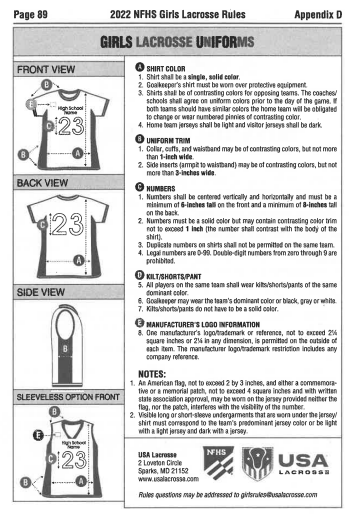
QUESTION: At the start of a cold weather game a couple of players on one of the teams has a different color under shirt (or leggings) of the rest of team, are they required to remove the undergarment or sit out during the game... or is the other team awarded a free position for a minor foul at the beginning of the game and those players are allowed to play with the non-compliant garments?
ANSWER: The scenario you presented is CORRECTABLE. Therefore it must be corrected or the athlete doesn't play in the game. An athlete cannot wear an illegal uniform (which is correctable) and just choose to take the penalty.
February 2024
QUESTION: Players often wear sweatshirts, or long sleeve shirts under their uniform to stay warm. The rule book stipulates that all players must wear the same color. When Lacrosse was a club sport this rule was not enforced. Will it be enforced now that it is a WIAA sport?
ANSWER: Yes. All NFHS Rules will be enforced.
Girls Lacrosse (Rule 2-9-5):
...All visible undergarments worn under the kilts/shorts/jerseys must be of one solid color, and must be white, gray, black or one of that team's uniform colors. All team members who choose to wear visible undergarments must wear the same color. This does not apply to medical sleeves or compression shirts that meet the NOCSAE ND200 lacrosse standard at the time of manufacture. Visible long or short-sleeved undergarments must correspond to the team's predominant jersey color or be light with light jersey and dark with a dark jersey.
Boys Lacrosse (Rule 1-9-2):
OPTIONAL ITEMS
a. Under-jerseys, if visible, shall:
1. Be a solid color which is white, gray or one of the team's official colors
2. Be the same color for those who choose to wear them
3. Be tucked into the pants if longer than belt length.
QUESTION: There are two REGIONAL playoff dates (May 23/24 and May 28). Will we need to have games on the 24th with the small number of teams we have this season?
ANSWER: Some teams will play the first round of Regionals. This will be determined after the seeding meetings are completed (May 12)
- BOYS Sectional 1 (19 teams): Seeds 14 - 19 will play the first round (May 24)
- BOYS Sectional 2 (20 teams): Seeds 13-20 will play the first round (May 24)
- GIRLS Sectional 1 and 2 (18 teams): Seeds 15-18 will play the first round (May 23)
QUESTION: Has there been a change to the Girls Lacrosse game format?
ANSWER: Yes. Games will now be played in FOUR 12-minute quarters (NFHS Rule 4-1-1)